The legal dispute between Formula 1 and the former promoter of the Russian Grand Prix has escalated into a financial battle of far greater scale than previously known, with a London court confirming that the championship’s counterclaim is “vastly greater” than the $24 million the Russian side is seeking to recover.
The ruling, handed down by the Commercial Court of England and Wales on 9 November 2026 in Rosgonki ANO v Formula One World Championship Ltd [2026] EWHC 2899 (Comm), addresses Formula 1’s application for security for legal costs but in doing so lays bare the true dimensions of the litigation.
The Origins of the Dispute
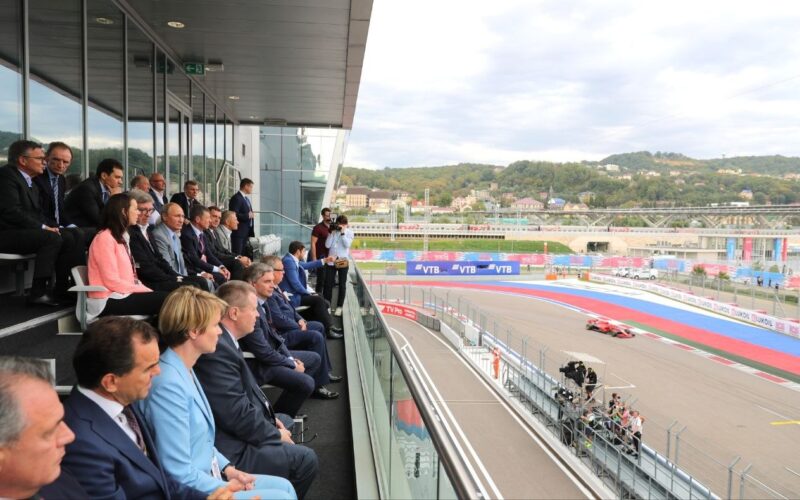
The Russian Grand Prix was held at the Sochi Autodrom from 2014 to 2021. A race was scheduled for 23–25 September 2022, with the event set to move to the Igora Drive circuit near St Petersburg from 2023.
Following Russia’s full-scale invasion of Ukraine, Formula 1 served a force majeure notice cancelling the 2022 race. On 2 March 2022, Formula One World Championship Limited terminated the contract entirely, citing the UK sanctions designation of Rosgonki’s founder, VTB Bank, as a material adverse change to the promoter’s financial circumstances.
Rosgonki had already paid approximately $24 million in advance for the 2022 event. The Russian organisation subsequently brought proceedings in the English High Court seeking repayment. According to the judgment, Formula 1 has conceded that Rosgonki has a prima facie entitlement to repayment arising from the force majeure notice — but the championship disputes that entitlement on other grounds.
The Counterclaim: “Vastly Greater”
Formula 1 is not merely defending against Rosgonki’s claim. It has filed a counterclaim for outstanding event fees under the terminated contract — and the court has confirmed it dwarfs the Russian demand.
In the judgment, the judge stated:
“the counterclaim is for a vastly greater sum than the claim” .
He elaborated:
“Rosgonki’s claim goes further than merely defending F1’s claim, because Rosgonki seeks a judgment requiring F1 to pay it US$24 million-odd, and F1’s claim goes further than merely defending Rosgonki’s claim, because F1 seeks a judgment requiring Rosgonki to pay it a sum very much larger than that” .
The judge further noted the substance of the proceedings:
“Rosgonki has nothing to prove at trial. Its prima facie entitlement to repayment of the US$24 million owed is conceded. Given that, the much larger size of the counterclaim, and the basis on which the counterclaim is advanced, it is at least as natural to view the proceedings as F1’s claim for that very large sum, which Rosgonki defends on various grounds” .
The precise figure of the counterclaim has not been disclosed in the public judgment.
Sanctions Defences
Formula 1 is running a multi-pronged sanctions defence against Rosgonki’s claim. According to the court record, F1 argues that:
-
UK sanctions prohibit payment to Rosgonki because it is controlled by VTB or by UK-sanctioned Russian Deputy Prime Minister Dmitry Chernyshenko, or that there is reasonable cause to suspect payment would make funds available to them in breach of sanctions;
-
US sanctions would be breached because payment would have to be made in US dollars, and enforcing it would be contrary to public policy;
-
Section 44 of the Sanctions and Anti-Money Laundering Act 2018 provides a defence, as F1’s failure to pay was based on a reasonable belief that payment was prohibited .
Security for Costs Ordered
The court partially granted F1’s application for security for costs, ordering Rosgonki to provide security limited to the sanctions defences. The judge found a high risk that an English costs order would not be enforced in Russia, and that Rosgonki has no assets outside Russia. However, the court did not accept that Rosgonki lacked the financial resources to pay costs, noting it remains an operating business .
The full trial is expected to be heard in June 2027 .