
The United States has escalated its campaign to isolate Iran’s financial lifelines by designating one of Russia’s largest banks for its role in facilitating Iranian sanctions evasion. On September 14, 2026, the Department of the Treasury’s Office of Foreign Assets Control (OFAC) designated VTB Bank Public Joint Stock Company for establishing correspondent banking relationships with sanctioned Iranian financial institutions, according to a Treasury press release.
The action falls under “Operation Economic Outcast,” a broader initiative announced by Treasury Secretary Scott Bessent on August 24, 2026, and described by the department as “Economic D-Day.” The operation is designed to sever what Treasury characterizes as the remaining economic lifelines sustaining the Iranian regime.
“Under Operation Economic Outcast, Treasury will continue to target and disrupt those who provide material, technological, or financial support that allows the Iranian regime to sustain its terrorist enterprise,” Bessent stated in the press release. “Treasury will not tolerate any support to the regime and will continue to identify, expose, and isolate Iran’s enablers.”
What VTB Is Accused Of
According to OFAC’s findings, VTB Bank has opened banking offices in Iran in recent years to formalize closer coordination with the Iranian regime and expand bilateral trade. Over the past three years, the bank established correspondent banking relationships with sanctioned Iranian financial institutions and began taking steps to increase its presence in Tehran starting in January 2025.
The Treasury Department specifically cited VTB’s efforts to move billions of frozen Iranian assets and its creation of a settlement system for national currencies through correspondent accounts in Iranian rials and Russian rubles, with the stated goal of increasing bilateral trade.
VTB Bank is now designated pursuant to Executive Order 13902, which targets certain sectors of the Iranian economy, including its financial sector. OFAC noted that VTB is now “among the most comprehensively sanctioned financial institutions in the world.”
This is not VTB’s first encounter with US sanctions. The bank was previously designated on January 15, 2025, under E.O. 13662 for operating in Russia’s financial services sector, and again on February 24, 2022, under E.O. 14024 for being owned or controlled by the Russian government.
The Man Behind VTB: Andrei Kostin
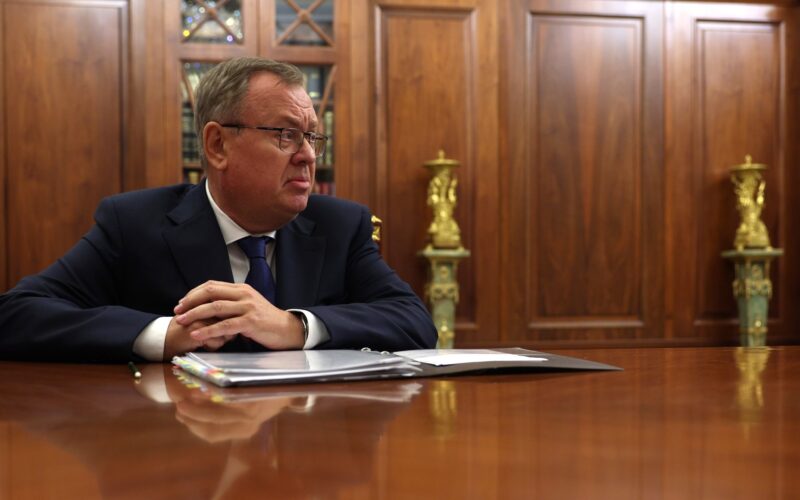
VTB Bank is led by President and Chairman of the Management Board Andrei (Andrey) Kostin, a figure with deep ties to the Russian state apparatus. Kostin has served as VTB’s CEO since June 2002, overseeing the bank’s transformation from Vneshtorgbank into one of Russia’s largest state-controlled financial institutions.
Kostin’s background reflects the intertwining of Russian financial and political power. Born in Moscow in 1956 to a father who worked in the Central Committee apparatus of the Communist Party, Kostin graduated from Moscow State University’s economics faculty in 1979 . He began his career in the Soviet Foreign Ministry, serving in the USSR’s consulate in Sydney and later at the embassy in London before entering the banking sector in the 1990s.
Kostin was appointed to lead Vnesheconombank (VEB) in 1996 and moved to VTB in 2002 . He has been described as a close associate of President Vladimir Putin, and the Kremlin’s official website has documented working meetings between the two, including one held as recently as July 2026 . Kostin also serves as chairman of the board of the United Shipbuilding Corporation, a strategic Russian state asset .
Following Russia’s full-scale invasion of Ukraine, Kostin was personally sanctioned by the European Union, the United Kingdom, Switzerland, Australia, and New Zealand .
Secondary Sanctions Risk and Global Implications
The Treasury’s action carries significant implications for foreign financial institutions. OFAC warned that “foreign financial institutions that continued to deal with VTB following its designation under OFAC’s Iran sanctions authorities are exposed to even more sanctions risk than before and should cut off those relationships immediately.”
This marks a critical escalation: VTB is now subject to dual sanctions regimes—one targeting Russia and another specifically addressing Iran’s financial sector. Financial institutions that maintain relationships with VTB now face heightened exposure under both frameworks.
The press release noted that Treasury is meeting with global financial institutions this week to provide information needed to shut down revenue streams and procurement networks tied to the Iranian regime, the Islamic Revolutionary Guard Corps (IRGC), and Iran’s terrorist proxies.
A Pattern of Targeting Third-Country Facilitators
The designation of VTB Bank follows recent Treasury actions targeting banks in Turkey and the United Arab Emirates. The Treasury characterized these actions as “a further warning to financial institutions and other foreign businesses that there is no safe way to do business with Iran.”
Under Operation Economic Outcast, Treasury has explicitly warned that any entity facilitating money laundering or sanctions evasion on behalf of Iran risks being cut off from the US financial system. The department has also signaled an accelerated pace of enforcement and emphasized secondary sanctions exposure for those continuing to do business with the Iranian regime.
Legal Consequences of the Designation
As a result of the designation, all property and interests in property of VTB Bank that are in the United States or in the possession or control of US persons are blocked and must be reported to OFAC. Any entities owned 50 percent or more, directly or indirectly, by the blocked bank are also subject to blocking.
OFAC’s regulations generally prohibit all transactions by US persons or within the United States that involve any property or interests in property of blocked persons, unless authorized by OFAC or otherwise exempt.
The Treasury emphasized that violations may result in civil or criminal penalties, with OFAC able to impose civil penalties on a strict liability basis. Non-US persons are also prohibited from causing or conspiring to cause US persons to violate US sanctions, as well as engaging in conduct that evades US sanctions.