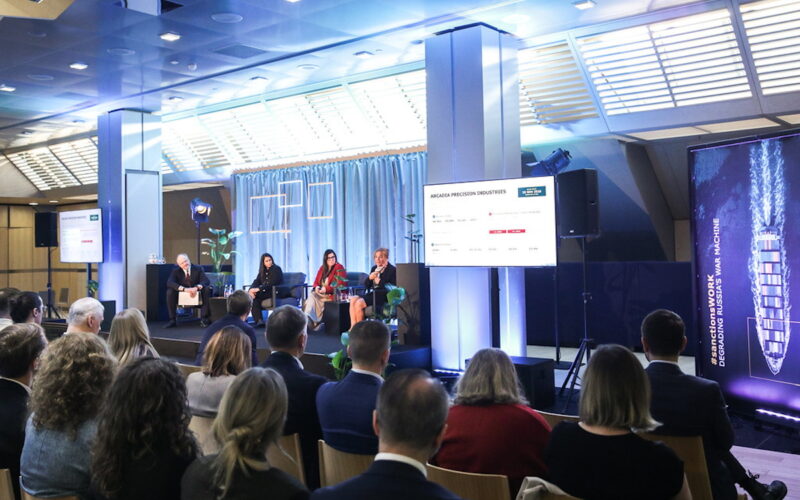
More than four years into Russia’s aggression against Ukraine, maintaining and strengthening the impact of sanctions on Russia remains a key priority for Latvia’s and Europe’s security. On 12 November 2026, the Financial Intelligence Unit of Latvia (FIU Latvia) brought together leading sanctions experts and decision-makers in Riga for its eighth annual international sanctions conference.
The conference, “Sanctions Work: Degrading Russia’s War Machine”, gathered around 140 experts from 24 countries, including speakers and participants from the United Kingdom, Canada, Ukraine, Germany, France, Belgium, Sweden, Poland and other countries.
“No Country Can Do This Work Alone”
In his opening remarks, Toms Platacis, Head of FIU Latvia, emphasised the need for coordinated action:
“How much more money, technology and equipment would Russia have without restrictions that have been made? This is the question we must ask ourselves when assessing the impact of sanctions. More than four and a half years after Russia launched its full-scale invasion of Ukraine, the aggression continues. Sanctions restrict Russia’s access to finance, technology and goods, and reduce the revenues funding the war. Our task is to make that pressure stronger. For Latvia, sanctions have been, and remain, a matter of national security. Latvia’s eastern border is also an external border of the European Union and NATO. Our common security is a shared responsibility. Russia continues to seek new ways around sanctions. We must respond by identifying new routes of circumvention, sharing information promptly and applying restrictions consistently across borders. No institution, and no country, should or can do this work alone. Each sees a different part of the picture. Bringing that knowledge together helps us identify risks and act on them”.
Focus on Export Controls and Circumvention Risks
Marta Tilhena, Head of the Sanctions Implementation Division at FIU Latvia, highlighted the specific challenges facing Latvia due to its geographical position:
“Latvia’s geographical location and its borders with Russia and Belarus shape our priorities in addressing sanctions circumvention risks. Particular attention must be paid to export controls, as the recent National Risk Assessment shows that approximately two-thirds of potential sanctions violations identified by customs authorities involve exports to third countries rather than directly to Russia or Belarus. This highlights the significant risk of goods being diverted to Russia through intermediary countries. We therefore work closely with companies exporting high-risk goods and strengthen information sharing with other public authorities and the financial sector. Suspicious transaction reports submitted by banks are particularly important in helping us identify potential sanctions circumvention schemes at an early stage”.
“Unjustified and Premature Sanctions Relief”
Yuliia Pavytska, Head of the Sanctions Hub of Excellence at the KSE Institute (Kyiv School of Economics), warned against complacency:
“We have already seen unjustified and premature sanctions relief for Russia, even though it pretends to make ‘progress’ in peace negotiations while destroying Ukraine’s energy and civilian infrastructure with renewed intensity. Meanwhile, the war in the Middle East has bought Russia additional time through windfall energy revenues. But these revenues are nowhere near enough to resolve the structural problems that have accumulated over more than four years of full-scale invasion and sanctions. As the sanctions coalition we must find ways to use economic pressure to finally bring Russia to the negotiating table ready to engage seriously. We have the tools”.
European Court of Auditors: Latvia as Good Practice
The latest report by the European Court of Auditors confirmed that EU sanctions have significantly affected trade with Russia, including bringing direct exports of high-priority and dual-use goods to a near halt. The report highlighted Latvia as an example of good practice, while also identifying areas for improvement, including stronger coordination between Member States, more consistent customs controls, better information sharing and more effective assessment of the impact of sanctions.
Latvia’s Centralised Sanctions Model
Since April 2024, Latvia has centralised responsibility for sanctions implementation within a single institution — FIU Latvia — combining financial intelligence, sanctions expertise and support for the public and private sectors. This model has been cited as a potential guide for other EU states.
A recurring message throughout the conference was that the effectiveness of sanctions should not be measured by the number of restrictions adopted, but by their actual impact on Russia’s ability to finance its war, obtain critical technologies and sustain military production.
The conference reinforced the importance of international cooperation, financial intelligence and practical solutions in further strengthening the impact of sanctions and safeguarding the shared security of Latvia and Europe.